
How to Choose Industrial Glue for Reliable Bonds
Amelia ParkerUpdated
A failed bond can halt a project for days and cost thousands in rework, wasted materials, and lost labour. Yet choosing the right industrial glue is still treated as an afterthought on too many UK construction and manufacturing sites. The confusion is understandable: there are dozens of adhesive types, competing claims on data sheets, and a web of BS EN standards that professionals must navigate to stay compliant. This guide cuts through that complexity. We walk you through adhesive types, application assessment, performance evaluation, and common pitfalls, giving you a clear, standards-led process you can apply to any project.
Table of Contents
- Understanding industrial glue types and standards
- Assessing application requirements: Materials, environment, and stress
- Evaluating glue performance: Strength, durability, and sustainability
- Common pitfalls and expert troubleshooting tips
- Our take: Why successful bonding is about more than just the adhesive
- Find your ideal industrial adhesive solution
- Frequently asked questions
Key Takeaways
| Point | Details |
|---|---|
| Prioritise BS EN standards | Always check adhesives for correct British and European certification to ensure compliance and safety. |
| Match glue to job | Select adhesives based on the specific materials, joints, and stresses of your application, not strength alone. |
| Sustainability matters | Modern UK projects often require low-VOC or water-based adhesives for environmental and workplace safety. |
| Avoid common mistakes | Poor preparation or the wrong glue type are leading causes of bond failure—review tips before application. |
Understanding industrial glue types and standards
With the risks clear, it helps to start with the fundamentals: what the main adhesive families are, what each does well, and how British and European standards shape which one belongs on your project.
The five types you will encounter most often in construction and manufacturing are:
- Epoxy adhesives – Two-part systems offering very high tensile and shear strength. Ideal for rigid substrates like steel, concrete, and composites where movement is minimal.
- Polyurethane-based adhesives – Flexible, moisture-tolerant, and excellent for bonding dissimilar materials. A strong choice where thermal movement or vibration is a factor.
- Acrylic adhesives – Fast-curing with good environmental resistance. Used widely in panel bonding and signage fabrication.
- Cyanoacrylate (CA) adhesives – Instant-bond, low-gap-fill products suited to small, close-fitting joints on non-porous surfaces.
- PVA adhesives – Water-based, low-VOC, and cost-effective for porous substrates like timber, but not suited to wet or high-stress environments.
For a practical example of solvent-based performance on mixed substrates, a contact adhesive based on neoprene chemistry delivers high initial grab on wood, metal, and laminates where water-based alternatives would struggle with open-time control.
| Adhesive type | Strength profile | Flexibility | VOC level | Typical use |
|---|---|---|---|---|
| Epoxy | Very high tensile/shear | Low | Low to medium | Structural steel, concrete |
| Polyurethane | High, with peel resistance | High | Medium | Timber, composite panels |
| Acrylic | High shear | Medium | Medium | Panel bonding, signage |
| Cyanoacrylate | High tensile (small areas) | Very low | Low | Close-fit rigid joints |
| PVA | Moderate | Low | Very low | Porous timber, interior use |
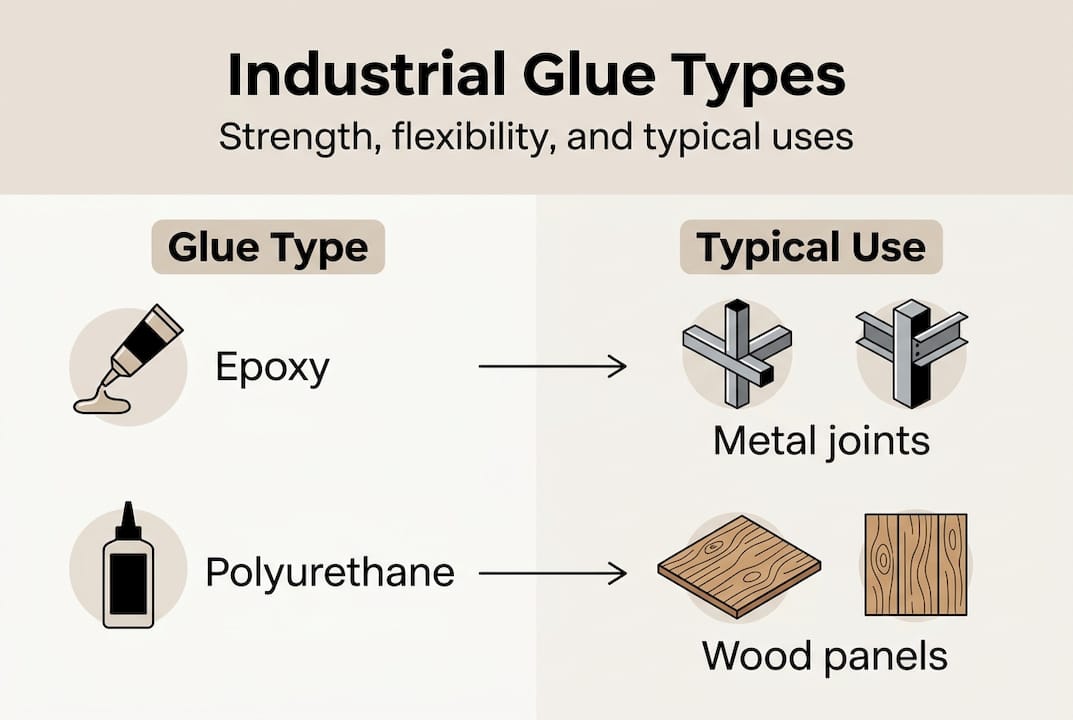
Where structural integrity is critical, BS EN standards are essential for regulatory compliance and specifying adhesives that meet defined performance thresholds. CE marking on a product confirms it has been tested to these benchmarks, which matters when you are working under building regulations or a quality management system.
The industry is also moving. Sustainability pressures are pushing manufacturers toward low-VOC and water-based formulations. For facade and glazing work, structural bonding tape now offers a solvent-free route to high-load bonding that would previously have required wet-applied epoxy or polyurethane systems.
When deciding between solvent-based and water-based options, the rule is straightforward: solvent-based products cure faster in cold or damp conditions and bond non-porous surfaces more reliably, while water-based systems are preferable indoors, on porous substrates, and wherever VOC limits apply.
Assessing application requirements: Materials, environment, and stress
Understanding glue types is vital, but matching them to your unique project requirements is where many professionals slip up. A systematic assessment before you open any cartridge saves time, money, and frustration.
Follow this sequence:
- Identify your substrates. List every material being bonded. Some adhesives are incompatible with certain plastics, foams, or treated surfaces. Always check the technical data sheet for substrate suitability.
- Define the load type. Is the joint under tensile pull, shear, peel, or a combination? Joint design influences stress distribution significantly, and a lap joint behaves very differently from a T-joint under load.
- Assess movement and vibration. Rigid epoxies perform poorly where substrates flex or vibrate. A flexible polyurethane or MS polymer system is more appropriate in those conditions.
- Consider environmental exposure. Will the bond face water immersion, UV, chemical splash, or temperature cycling? Each factor narrows your adhesive options.
- Check indoor air quality requirements. For occupied buildings or food-processing environments, VOC limits may be legally binding.
For situations where substrates are uneven or gaps are present, gap-filling adhesives bridge voids that would cause stress concentrations in a thin-film system. For floor coverings in commercial settings, a dedicated flooring adhesive accounts for the specific peel and shear forces that foot traffic and thermal cycling impose.
| Requirement | Recommended adhesive type |
|---|---|
| High rigidity, static load | Epoxy |
| Movement or vibration | Polyurethane or MS polymer |
| Wet or humid environment | Polyurethane or hybrid |
| Indoor, low-VOC required | Water-based PVA or acrylic |
| Uneven or porous surfaces | Gap-filling polyurethane |
Pro Tip: Always match the adhesive to the weakest substrate in the joint, not the strongest. Bonding a thin composite panel to steel with a rigid, high-strength epoxy can cause the panel to fracture before the adhesive fails. A slightly lower-strength, flexible system that distributes stress across the full bond area will outperform it in practice.
Evaluating glue performance: Strength, durability, and sustainability
Once your key requirements are assessed, the next step is weighing how glues perform in the real world and on the environment. Technical data sheets are your primary tool here, and knowing what to read on them is a skill worth developing.
When reviewing a data sheet, focus on:
- Tensile strength – The force required to pull the bond apart perpendicular to the joint surface, measured in N/mm².
- Shear strength – Resistance to forces acting parallel to the bond plane. Critical for lap joints.
- Peel strength – Resistance to progressive separation from one end of a flexible bond. Important for tapes and flexible adhesives.
- Cure time and open time – How long you have to position substrates and how long before the joint can be loaded.
- Temperature range – Both during application and in service. Some adhesives become brittle below 0°C or soften above 60°C.
- Chemical resistance – Relevant for industrial environments with oil, fuel, or cleaning agent exposure.
For versatile site use, a hybrid sealant and adhesive combines the flexibility of MS polymer chemistry with strong adhesion across a wide range of substrates, making it a practical choice when you need one product to cover multiple joint types. Where VOC reduction is a priority, a solvent-free adhesive delivers reliable performance without compromising indoor air quality.
Certifications matter. A BS EN marking on a product is not just a label: it is evidence that the adhesive has been independently tested to defined performance criteria. Always request the declaration of performance document when specifying adhesives for structural or regulated applications.
Sustainability is now influencing adhesive selection, with low-VOC and water-based options becoming standard across many UK project specifications. That said, environmental credentials should never come at the cost of bond integrity.
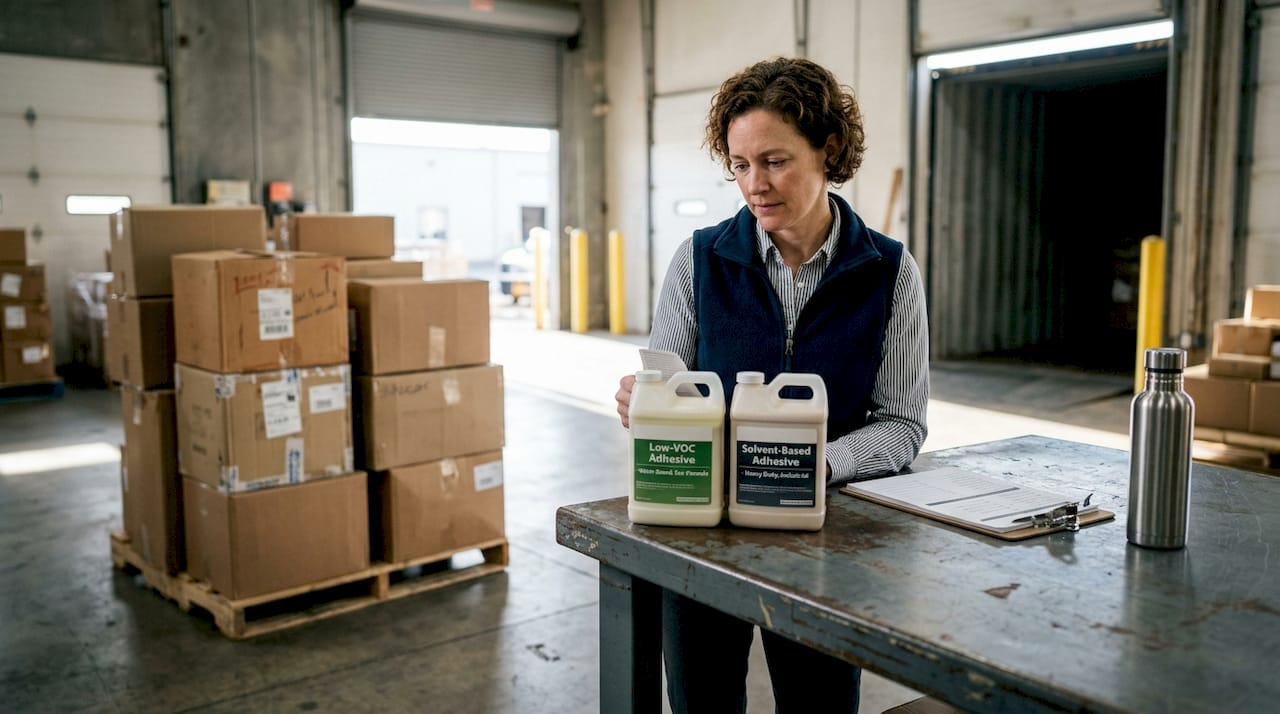
Pro Tip: Do not sacrifice durability for sustainability. The best products on the market now deliver both. Look for adhesives that carry low-VOC certification and meet BS EN strength requirements simultaneously. They exist, and they are worth the extra specification effort.
Common pitfalls and expert troubleshooting tips
Even a well-chosen adhesive can fail if selection or application errors creep in. Here is what to avoid and how to address problems when they arise.
The most frequent selection and application errors:
- Skipping surface preparation. Contamination from oil, dust, moisture, or release agents is the leading cause of bond failure. Clean, abrade, and prime as the data sheet specifies.
- Mismatching adhesive to substrate. Choosing a rigid system for a flexible substrate, or a water-based product for a non-porous surface, will produce a weak or non-existent bond.
- Ignoring standards. Overlooking BS EN requirements on a regulated project creates liability and risks non-compliance with building regulations.
- Applying outside the stated temperature range. Many adhesives will not cure correctly below 5°C or above 35°C.
- Using expired product. Adhesives have shelf lives. An out-of-date cartridge may appear normal but will underperform significantly.
Troubleshooting common failures:
- Debonding after cure: Check surface prep records and confirm substrate compatibility. Re-abrade, clean with an appropriate solvent, and re-bond.
- Creep under sustained load: The adhesive may be too flexible for a static structural joint. Switch to a higher-modulus system.
- Poor or slow cure: Verify temperature and humidity at application. Some systems require a primer or activator on low-energy surfaces.
For demanding joints where both sealing and adhesion are required, an MS polymer adhesive sealant offers excellent adhesion without a primer on most substrates and remains workable across a wide temperature range.
Joint geometry, preparation, and application technique are as important as adhesive choice. A premium product applied incorrectly will consistently underperform a mid-range product applied with care and the right technique.
Pro Tip: Always test a small area before full application on a new substrate or in unfamiliar conditions. A 24-hour test bond costs nothing and can prevent a costly failure across an entire run.
Safety note: When working with solvent-based adhesives, ensure adequate ventilation and wear appropriate PPE including gloves, eye protection, and a respirator rated for organic vapours. Check the product safety data sheet before use.
Our take: Why successful bonding is about more than just the adhesive
There is a persistent habit in the industry of chasing ultimate strength. Professionals assume that the highest-rated adhesive on the shelf is automatically the best choice. In our experience, that assumption causes as many failures as it prevents.
A bond is a system. The adhesive is one component. Surface preparation, joint design, application technique, cure conditions, and ongoing load management all contribute to whether that bond performs over its intended service life. We have seen structural bonding applications succeed with moderate-strength systems because the preparation and joint geometry were correct, and fail with premium products because neither was.
Compliance with BS EN standards is not bureaucratic overhead. It is the framework that ensures every variable in that system has been considered. Professionals who treat standards as a checklist rather than a process tend to cut corners at the preparation stage, and that is where failures originate.
Our advice: invest as much attention in your application process as you do in product selection. The two are inseparable.
Find your ideal industrial adhesive solution
Selecting the right adhesive is straightforward when you have the right products and the right guidance behind you.
At Stick2Products, we stock a full range of industrial adhesives mapped to the requirements covered in this guide, from contact adhesive for wood and metal to hybrid sealant and adhesive systems for complex multi-substrate joints. Every product we supply meets relevant UK quality standards, and our technical team is available to help you match the right solution to your specific project. Browse our full adhesive range or get in touch for project-specific advice. Next-day delivery means you are never far from the right bond.
Frequently asked questions
What is the most important factor when choosing industrial glue?
Matching the adhesive to your specific materials, load demands, and environmental exposure is the primary consideration. BS EN standards are essential for structural applications and regulatory compliance across UK construction and manufacturing projects.
How do sustainability regulations impact adhesive selection in the UK?
UK project specifications increasingly require low-VOC or water-based adhesives for indoor and environmentally sensitive applications. Sustainability is now influencing standard adhesive procurement across the construction sector.
What happens if the wrong type of glue is selected?
Selecting the wrong adhesive can result in bond failure, safety risks, costly rework, and non-compliance with building regulations. UK professionals must focus on BS EN compliance to avoid these outcomes.
How can I tell if a glue meets UK construction standards?
Look for BS EN certification and a declaration of performance document on the product label or in the technical documentation. BS EN standards are the benchmark for adhesive compliance across UK construction and industrial applications.